Auto Social Posts: Automation at Scale for 2026
· 11 min read

Managing multiple social media accounts while maintaining consistent posting schedules demands time most businesses and creators simply don't have. Auto social posts offer a solution by automating content creation and distribution across platforms, freeing teams to focus on strategy and engagement. The challenge isn't just automating the mechanics of posting-it's doing so while preserving authentic voice, analyzing what resonates with audiences, and scaling operations without sacrificing quality. In 2026, the most effective automation strategies combine intelligent content analysis with platform-specific optimization to deliver results that manual posting simply cannot match.
Understanding Auto Social Posts Infrastructure
Auto social posts rely on sophisticated technical infrastructure that connects content creation tools with platform APIs. Each major social network provides developer access for programmatic posting, though implementation requirements vary significantly.
The foundation begins with API integration. Platforms like Instagram use a container-based publishing flow that requires creating a media container before publishing, while X (formerly Twitter) offers more direct endpoints. Understanding these technical requirements determines what automation is possible and which workflows deliver the best results.
Platform-Specific Automation Capabilities
Different networks support different automation features. Here's how major platforms compare:
| Platform | Scheduling API | Content Types | Rate Limits | Authentication |
|---|---|---|---|---|
| Container-based | Photo, Video, Carousel, Reels | 25 posts/day | OAuth + Business Account | |
| X (Twitter) | Direct + Scheduled | Text, Images, Video, Polls | 300 posts/3 hours | OAuth 2.0 |
| Direct | Text, Images, Video, Documents | 100 posts/day | OAuth 2.0 | |
| Graph API | All formats | Platform dependent | App + Page tokens |

The technical landscape continues evolving. X recently expanded its scheduling capabilities through developer APIs, allowing programmatic future posting with precise timestamp control. These advances enable more sophisticated automation workflows but require staying current with documentation and rate limit changes.
Content Analysis and Pattern Recognition
The most powerful auto social posts systems don't just schedule content-they analyze what performs well and replicate those patterns. This involves breaking down successful posts to identify key elements: hook structures, visual composition, caption length, emoji usage, call-to-action placement, and timing patterns.
Pattern recognition goes beyond simple metrics. Advanced systems examine viral posts within specific niches to understand contextual factors: why certain formats resonate with particular audiences, how trending topics integrate into brand messaging, and which creative approaches maintain authenticity while driving engagement.
Key elements automation systems analyze:
- Opening hook word count and structure
- Visual hierarchy and composition patterns
- Hashtag count, placement, and relevance
- Caption storytelling arc and pacing
- Call-to-action specificity and positioning
- Cross-reference with engagement data
- Platform-specific format optimization
By learning from proven winners, automation systems create new content that starts from a foundation of demonstrated success rather than guesswork. This data-driven approach significantly improves the baseline performance of auto social posts.
Building Scalable Content Workflows
Scaling social media operations requires moving beyond individual post creation to systematic workflows that maintain quality across dozens or hundreds of posts monthly. The workflow architecture determines both output volume and consistency.
Successful scaling starts with content profile development. Rather than creating each post from scratch, establish templates and style guides that capture brand voice, visual identity, and messaging frameworks. These profiles become the foundation for automated content generation.
Multi-Account Management Strategies
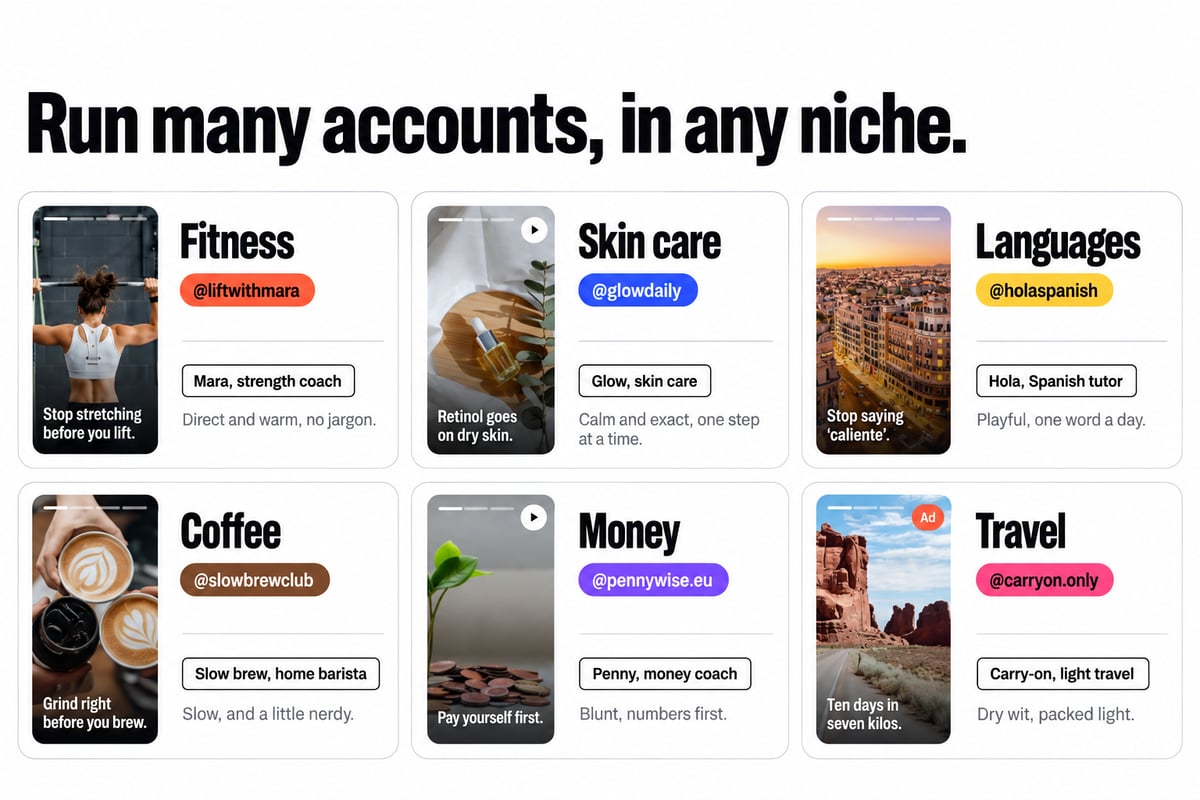
Running multiple social accounts-whether for different brands, product lines, or market segments-introduces complexity that manual posting cannot efficiently handle. Auto social posts excel in this environment when properly structured.
Organizational framework for multi-account operations:
- Profile segregation: Maintain distinct content profiles for each brand voice and audience
- Asset libraries: Create centralized media repositories tagged by campaign, theme, and usage rights
- Approval workflows: Route content through stakeholder review before scheduling
- Performance dashboards: Track metrics across all accounts in unified reporting
- Cross-posting rules: Define which content variants work across multiple accounts
The operational efficiency compounds as account count increases. Managing ten accounts with automation requires roughly the same effort as managing three manually, shifting the constraint from time to strategy and creative direction.

Quality Control in Automated Systems
Automation without quality control produces mediocre content at scale. The goal isn't maximum volume-it's optimal volume with consistent quality that aligns with brand standards.
Implement multi-layer quality checks:
- Pre-generation validation: Verify source assets meet resolution, format, and rights requirements
- Content review queues: Route generated posts through human approval before scheduling
- A/B variant testing: Generate multiple versions of each post concept for performance comparison
- Engagement monitoring: Flag underperforming content patterns for profile adjustment
- Compliance verification: Check disclosure requirements and platform policies before publishing
trendoo addresses this quality challenge by learning your specific style from posts you select, then generating original content in that voice. Rather than templated outputs that feel robotic, the system creates unique posts that maintain your established tone while incorporating proven viral patterns. Start building your content profiles to see how automation can maintain quality at scale.
Compliance and Accessibility in Automation
Auto social posts must navigate complex regulatory requirements and accessibility standards. Ignoring these creates legal exposure and excludes significant audience segments.
Legal Requirements for Automated Content
The FTC's guidance on endorsements and influencer marketing applies regardless of whether content is manually created or automated. Material connections must be clearly disclosed, and automated systems must include disclosure mechanisms.
Compliance checklist for auto social posts:
- Clear, conspicuous disclosure language for sponsored content
- Hashtags like #ad or #sponsored in visible positions
- Disclosure on every platform where content appears
- Documentation of automated posting for audit purposes
- Review processes for advertiser-supplied content
- Age-appropriate content filtering and verification
Platform policies add another layer. When automating content that includes AI-generated elements, many networks now require explicit labeling following updates like Google's deepfake content policies. Build these labels into your automation templates rather than adding them manually post-generation.
Accessibility Standards for Social Content
The W3C's ATAG guidelines for social media establish accessibility requirements for automated authoring tools. Your auto social posts system must support creating accessible content, not just publishing quickly.
Essential accessibility features in automation:
| Requirement | Implementation | Why It Matters |
|---|---|---|
| Alt text generation | Automated descriptive text for images | Screen reader access for visually impaired users |
| Caption inclusion | Automatic captions for video content | Accessibility for deaf/hard-of-hearing audiences |
| Color contrast | Verify text readability on backgrounds | Low vision accessibility |
| Emoji description | Context for decorative elements | Screen reader compatibility |
| Plain language | Simplified alternative text options | Cognitive accessibility |
The broader WCAG 3.0 draft standards provide additional guidance on creating perceivable, operable, and understandable content. Auto social posts systems should include accessibility checks in their validation workflows, flagging content that fails contrast ratios or lacks necessary text alternatives.
Strategic Considerations for Automation
Simply automating existing manual processes rarely produces optimal results. The most successful implementations rethink strategy from the ground up based on what automation enables.
Audience and Platform Selection
Not all platforms and audiences benefit equally from automated posting. Recent research on social media usage patterns reveals shifting demographics and engagement patterns that should inform your automation strategy.
Platform-audience fit for auto social posts:
- Instagram: Visual-first audiences, high engagement with consistent aesthetic brands
- X (Twitter): Real-time conversation, trending topics, news-oriented content
- LinkedIn: Professional audiences, B2B content, thought leadership
- Facebook: Broad demographics, community building, long-form native content
- TikTok: Younger audiences, video-first, algorithm-driven discovery
Match your automation investment to platforms where your target audience actively engages. Spreading thin across every network dilutes impact-concentrate automated efforts where ROI is demonstrable.

Balancing Automation with Authenticity
The HBR analysis of marketing's shifting social investment highlights a critical tension: audiences increasingly detect and reject inauthentic content, even as automation becomes more sophisticated. Success requires automation that enhances rather than replaces human creativity.
Strategies for maintaining authenticity:
- Generate content frameworks, not finished posts
- Use automation for distribution timing, not all creation
- Inject real-time responses and trending references manually
- Rotate content patterns to avoid predictable formulas
- Reserve breaking news and crisis response for human posting
- Blend automated and organic content in feed mix
The goal is leveraging automation for efficiency while preserving the unique perspective and voice that makes your content valuable. Auto social posts should amplify your team's capabilities, not substitute for authentic communication.
Measurement and Optimization Frameworks
Automation without measurement produces volume without learning. Structured analytics turn auto social posts into continuously improving systems.
Tracking Performance Across Automated Content
Connect social automation to comprehensive analytics using tools like Google Analytics for social media measurement. This integration reveals which automated content drives meaningful business outcomes, not just vanity metrics.
Essential metrics for automated content:
- Engagement rate: Interactions per impression (likes, comments, shares)
- Click-through rate: Traffic driven to owned properties
- Conversion attribution: Sales or leads from social traffic
- Audience growth: Net follower increase from content campaigns
- Engagement quality: Comment sentiment and conversation depth
- Time-to-engagement: How quickly posts generate interactions
- Share of voice: Brand mentions relative to competitors
Track these metrics at multiple levels: individual post performance, content profile effectiveness, platform ROI, and overall automation impact on business goals.
Iterative Profile Refinement
The most effective auto social posts systems learn continuously. As performance data accumulates, refine content profiles to emphasize high-performing patterns and eliminate underperforming approaches.
Establish a regular optimization cycle:
- Weekly: Review top and bottom performers, identify pattern shifts
- Monthly: Adjust content profiles based on aggregated performance data
- Quarterly: Reevaluate platform mix and overall automation strategy
- Annually: Comprehensive audit of automation ROI and strategic alignment
This iterative approach transforms auto social posts from a set-and-forget tool into a dynamic system that improves with every post. The data generated by automation at scale provides insights impossible to gather from manual posting, creating a competitive advantage that compounds over time.
Advanced Automation Techniques
As basic automation becomes standard practice, competitive advantage shifts to sophisticated implementations that extract maximum value from automated systems.
Dynamic Content Assembly
Rather than generating complete posts, advanced systems assemble content dynamically from component libraries: hooks, body copy modules, visual templates, call-to-action variations, and hashtag sets. This modular approach enables testing thousands of combinations to identify optimal configurations.
Component library structure:
- Hooks (15-20 variants): Opening lines tested for stop-scroll effectiveness
- Body modules (25-30 variants): Core message delivery in different storytelling formats
- Visual templates (10-15 variants): Design frameworks for consistent brand aesthetics
- CTAs (8-10 variants): Action-driving closers with different urgency levels
- Hashtag sets (12-15 variants): Tag combinations for different audience segments
Dynamic assembly multiplies creative possibilities without proportional time investment. A library with just 20 hooks, 30 body modules, 15 visuals, and 10 CTAs can generate 90,000 unique post combinations.
Cross-Platform Adaptation Workflows
Content rarely performs optimally when posted identically across platforms. Auto social posts systems should automatically adapt content to each network's format requirements, audience expectations, and algorithm preferences.
Platform-specific adaptations:
| Source Content | Instagram Adaptation | X Adaptation | LinkedIn Adaptation |
|---|---|---|---|
| Long-form article | Carousel summary with key points | Thread breaking down insights | Professional takeaway with link |
| Product demo video | 60-second Reel with captions | 2-minute upload with commentary | Brief clip with use case context |
| Customer testimonial | Story highlight + feed post | Quote graphic with thread | Case study snippet with metrics |
| Company milestone | Behind-scenes visual story | Celebratory announcement thread | Achievement post with team recognition |
Automated adaptation maintains core messaging while optimizing presentation for each platform's unique environment. This sophisticated approach delivers better performance than manual cross-posting ever could at comparable scale.
Predictive Scheduling Optimization
Moving beyond fixed posting schedules, advanced automation uses historical performance data to predict optimal posting times for specific content types and audience segments. Machine learning models analyze engagement patterns across variables including day of week, time of day, content format, topic category, and current trending topics.
Predictive models can identify non-obvious patterns: certain product categories perform better on Tuesday afternoons, educational content peaks Wednesday mornings, or promotional posts see higher conversion on weekend evenings. Auto social posts systems incorporating these insights schedule content when each specific post type has the highest probability of success.
Building Your Automation Infrastructure
Implementing auto social posts requires technical infrastructure, process development, and team alignment. Start with a phased approach that builds capability progressively.
Phase One: Foundation (Weeks 1-4)
Begin with single-platform automation focused on your highest-ROI network. Establish core infrastructure without overwhelming your team:
- Select primary automation platform and complete API integration
- Create 3-5 content profiles representing your core brand voices
- Build initial asset library with 50-100 tagged media items
- Establish approval workflow and quality control process
- Schedule first month of automated content (4-6 posts weekly)
This foundation phase proves the concept while developing team familiarity with automation workflows.
Phase Two: Expansion (Weeks 5-12)
With foundation stable, expand to additional platforms and increase posting volume:
- Add 2-3 additional social platforms to automation system
- Develop platform-specific content profiles and adaptation rules
- Expand asset library to 200-300 items with comprehensive tagging
- Increase posting frequency to 10-15 posts weekly across platforms
- Implement A/B testing framework for content variants
- Connect analytics and begin systematic performance tracking
Expansion phase builds operational scale while maintaining quality standards established in foundation phase.
Phase Three: Optimization (Weeks 13-24)
Final phase focuses on refinement and advanced techniques:
- Implement predictive scheduling based on accumulated performance data
- Develop dynamic content assembly from component libraries
- Add multi-account management for brand portfolio or market segments
- Establish iterative profile refinement based on continuous learning
- Scale to 20-30 posts weekly with maintained or improved engagement rates
- Document full automation playbook for team onboarding and consistency
By week 24, you've built a mature automation infrastructure that consistently produces high-quality content at scale across multiple platforms and accounts.
Real-World Performance Benchmarks
Understanding realistic performance expectations helps set appropriate goals for auto social posts implementations. Benchmarks vary significantly by industry, audience size, and platform, but general patterns emerge.
Engagement Rate Expectations
| Account Size | Manual Posting Avg | Auto Posts (Basic) | Auto Posts (Optimized) |
|---|---|---|---|
| Under 10K followers | 3.2% | 2.1% | 3.8% |
| 10K-50K followers | 2.1% | 1.4% | 2.9% |
| 50K-100K followers | 1.8% | 1.1% | 2.4% |
| Over 100K followers | 1.2% | 0.8% | 1.6% |
Basic automation typically underperforms manual posting initially due to learning curve and template-based approaches. Optimized automation-using pattern recognition, profile learning, and continuous refinement-exceeds manual posting by 15-35% through consistent quality, optimal timing, and data-driven content decisions.
Volume and Efficiency Gains
The productivity impact of auto social posts is substantial. A team managing five accounts manually typically produces 15-20 posts weekly at 8-10 hours effort. The same team with optimized automation produces 40-50 posts weekly at 4-6 hours effort-a 200%+ volume increase with 40% time reduction.
These efficiency gains free teams for higher-value activities: strategy development, community engagement, influencer relationships, and creative direction. Automation handles execution while humans focus on activities requiring judgment, empathy, and creative thinking.
Auto social posts represent the convergence of content intelligence, platform APIs, and operational efficiency. The most successful implementations analyze what works, maintain authentic voice, and scale systematically while preserving quality. When you're ready to transform social posting from daily grind to strategic advantage, trendoo learns from viral patterns in your niche and generates original content in your voice-giving you proven starting points that scale across all your accounts and profiles.