Automated Social Posting: Scale Your Content in 2026
· 8 min read

Managing multiple social media accounts while maintaining consistent quality and engagement feels overwhelming for most brands and creators. Automated social posting has evolved from simple schedulers into intelligent systems that analyze what works, adapt to your voice, and publish at scale without sacrificing authenticity. The challenge isn't just posting more-it's posting smarter while keeping your unique style intact across every platform and audience segment.
Understanding Modern Automated Social Posting
Automated social posting refers to systems that create, schedule, and publish social media content with minimal manual intervention. Unlike early automation tools that simply queued pre-written posts, modern platforms analyze performance patterns, generate original content, and adapt to each platform's requirements.
The technology has matured significantly since 2020. Today's solutions leverage pattern recognition to understand what makes content resonate with specific audiences. They maintain brand consistency while producing hundreds of variations tailored to different segments, times, and platforms.
The Evolution Beyond Basic Scheduling
Traditional scheduling tools required you to write every post manually, then set a publication time. Modern automated social posting platforms take a fundamentally different approach:
- Pattern analysis that identifies what makes successful content work
- Style learning that captures your brand voice from existing posts
- Original generation that creates new content rather than recycling old material
- Multi-account management that scales across dozens of profiles simultaneously
- Performance tracking that shows which automated posts drive real engagement
This shift matters because brands now compete against thousands of posts daily. According to Pew Research data on social media usage, the average user scrolls past 300-500 social posts every day. Breaking through requires both volume and precision.

Building Content Profiles That Capture Your Voice
The foundation of effective automated social posting lies in teaching the system what your brand sounds like. Content profiles serve as style guides that preserve tone, structure, and messaging across every automated post.
Start by identifying 10-15 posts that perfectly represent your brand. These become training examples that reveal patterns in your communication style. The system analyzes sentence structure, vocabulary choices, emoji usage, hashtag strategy, and call-to-action phrasing.
Creating Multi-Profile Strategies
Many brands need different voices for different audiences. A software company might maintain separate profiles for developers, business decision-makers, and end users. Each profile generates automated social posting content with distinct characteristics:
| Profile Type | Tone | Content Focus | Typical Format |
|---|---|---|---|
| Developer-focused | Technical, precise | API features, integration guides | Code snippets, documentation links |
| Executive-focused | Strategic, ROI-driven | Business outcomes, case studies | Statistics, testimonials |
| User-focused | Friendly, helpful | Tips, tutorials, success stories | How-to videos, quick wins |
This segmentation ensures automated posts feel personal rather than generic. Each audience receives content that speaks their language and addresses their specific concerns.
Maintaining Authenticity at Scale
The biggest objection to automated social posting is the fear of sounding robotic. Quality systems avoid this by generating original content rather than templating variations. Every post uses new phrasing and structure while maintaining your established voice.
Test your automated content by mixing it with manually written posts, then asking your team to identify which is which. If they can't tell the difference consistently, your automation maintains authentic voice successfully.
Platform-Specific Optimization
Each social platform has unique requirements, audience expectations, and performance algorithms. Effective automated social posting adapts content for each destination rather than broadcasting identical messages everywhere.
LinkedIn favors longer-form insights and professional commentary. Twitter demands concise, punchy statements with strategic hashtag use. Instagram prioritizes visual storytelling with captions that complement imagery. LinkedIn's Posts API documentation outlines specific formatting requirements and rate limits that automation systems must respect.
Technical Compliance Requirements
Automated posting systems must comply with platform-specific developer policies and API restrictions. YouTube's developer policies set clear boundaries around programmatic uploads, quota management, and metadata requirements. Violations result in API access suspension or account penalties.
Key compliance considerations include:
- Rate limiting - respecting maximum posts per hour/day
- Authentication protocols - maintaining secure OAuth connections
- Content policies - avoiding spam patterns and prohibited material
- Accessibility standards - following W3C ATAG guidance for alt text and captions
- Metadata accuracy - ensuring tags, descriptions, and links are valid
Automated systems that ignore these requirements create compliance risks that outweigh any efficiency gains.
Analyzing Viral Content for Better Automation
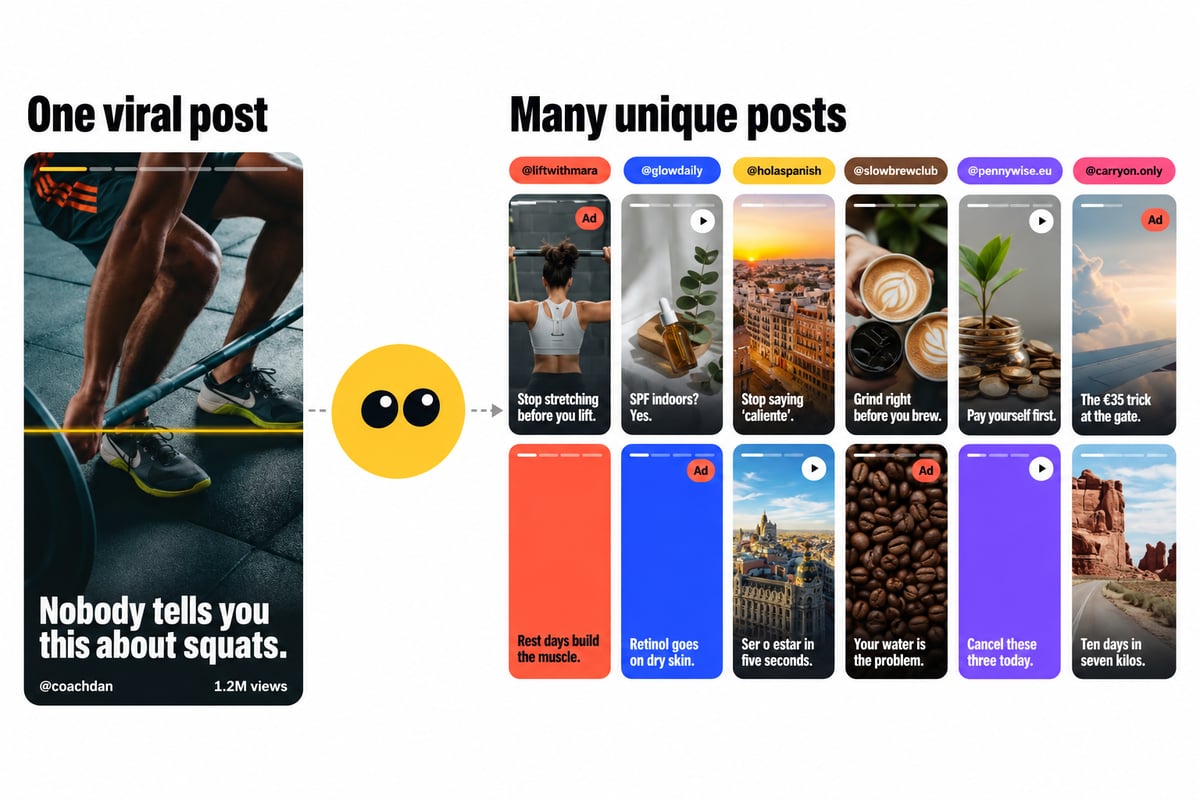
The most sophisticated automated social posting platforms learn from what's already working in your niche. Instead of guessing what might perform well, they analyze posts that have demonstrated viral success.
This approach starts with identifying high-performing content in your industry. When you find a post with exceptional engagement, the system deconstructs its structure, messaging approach, hook strategy, and presentation format. It identifies the underlying principles that made that content resonate without copying the specific execution.

Translating Patterns Into Original Posts
Learning from viral content doesn't mean replicating it. The goal is understanding why certain approaches work, then applying those principles to your unique brand and message. An automated social posting system might notice that posts starting with surprising statistics generate 3x more engagement, then incorporate that pattern into your content while using your own data and voice.
For creators and app marketers who need to maintain multiple accounts with different angles, trendoo learns from viral posts in your niche and generates original content that applies those successful patterns to your specific product and style. The platform analyzes what made a post take off, captures your voice through content profiles, and produces slideshows and videos at scale without ever copying the original material.
Measuring What Actually Drives Results
Automated posting generates more content than any team could track manually. IAB measurement guidelines provide standards for evaluating performance consistently across platforms and campaigns.
Focus on metrics that indicate genuine engagement rather than vanity numbers:
- Save rate - indicates content valuable enough to reference later
- Share rate - shows content worth recommending to others
- Comment quality - measures depth of audience connection
- Click-through rate - demonstrates content drives intended actions
- Follower conversion - tracks how posts attract new audience members
Track these metrics by content profile, posting time, platform, and format. The patterns reveal which automated social posting strategies deserve more investment and which need refinement.
Managing Multiple Accounts Efficiently
Brands and agencies often manage dozens of social accounts simultaneously. Automated social posting becomes essential when you're responsible for publishing content across 10+ profiles daily while maintaining quality and consistency.
Centralized dashboards provide visibility into every account's status. You see which posts published successfully, which are queued for upcoming time slots, and which triggered warnings or errors. This overview prevents gaps in your publishing calendar and identifies problems before they compound.
Account Organization Strategies
Structure your account management around logical groupings:
- By brand - separate divisions or product lines
- By geography - regional accounts with localized content
- By audience segment - different buyer personas or use cases
- By content type - educational, promotional, community-focused
Each grouping can have distinct content profiles and posting cadences while sharing underlying brand guidelines and visual assets.
Workflow Coordination
Even with automation, someone needs oversight. Establish clear workflows for:
- Approving new content profiles before they generate posts
- Reviewing automated posts at appropriate intervals (daily for new profiles, weekly for established ones)
- Responding to engagement that automated systems flag for human attention
- Updating brand guidelines when messaging or positioning shifts
- Analyzing performance reports to refine automation parameters
This structure ensures automated social posting enhances team productivity rather than creating new coordination headaches.
Accessibility in Automated Content
Automated posting systems must produce accessible content that serves all users effectively. WCAG 3.0 standards establish requirements for digital content that apply to social media automation tools.
Essential accessibility features include:
- Automatic alt text generation for images and graphics
- Transcript creation for video and audio content
- Caption timing that synchronizes with spoken content
- Hashtag capitalization (CamelCase) for screen reader compatibility
- Emoji descriptions that convey meaning to non-visual users
Quality automated social posting platforms build these capabilities into their content generation workflow rather than treating accessibility as an afterthought. This ensures every post reaches your entire audience regardless of how they access social media.
Testing Automated Content for Accessibility
Validate that your automated posts meet accessibility standards by:
- Running posts through screen readers before publication
- Checking color contrast ratios in graphics and overlays
- Verifying video captions for accuracy and timing
- Confirming alt text describes images meaningfully rather than generically
- Testing keyboard navigation through any linked content
These checks become particularly important at scale. A single accessibility error in a template multiplies across hundreds of automated posts, potentially excluding significant audience segments.
Balancing Automation with Human Creativity
The goal of automated social posting isn't eliminating human involvement-it's amplifying human creativity by removing repetitive execution tasks. Your team should spend time on strategy, big ideas, and high-value engagement rather than manually formatting and scheduling routine posts.
Define clear boundaries between what automation handles and what requires human judgment. Automation excels at maintaining consistent publishing schedules, adapting proven formats to new topics, and ensuring technical compliance. Humans excel at responding to breaking news, managing sensitive situations, and creating genuinely innovative campaigns.
When to Override Automation
Keep manual control over:
- Crisis communications requiring immediate, thoughtful responses
- Major announcements that deserve custom creative treatment
- Real-time events where timing matters more than consistency
- Sensitive topics that need careful tone and framing
- Experimental formats testing new content approaches
Automated social posting works best when it handles the foundation while preserving capacity for moments that demand human creativity and judgment.
Scaling Content Production Sustainably
Growth eventually outpaces any team's manual capacity. Automated social posting enables sustainable scaling by maintaining quality standards even as publishing volume increases dramatically.
Start with one account and perfect your approach before expanding. Once your first automated profile consistently generates on-brand content and drives engagement, duplicate that success across additional accounts. This methodical approach prevents the chaos of trying to automate everything simultaneously.
Pricing Models and ROI Calculation
Evaluate automated social posting platforms based on total cost of ownership, not just subscription fees. Consider:
| Cost Factor | Manual Approach | Automated Approach |
|---|---|---|
| Staff time | 20-30 hrs/week per account | 2-3 hrs/week oversight |
| Content creation | $50-150 per post | $5-15 per post (platform fee + review) |
| Scheduling tools | $50-200/month | Included in platform |
| Performance tracking | Separate analytics subscription | Integrated dashboard |
| Multi-account management | Linear cost increase | Marginal cost per account |
Many platforms, including those at trendoo's pricing, offer introductory rates that reduce first-month costs while you validate fit and refine your approach.

Adapting to Platform Algorithm Changes
Social platform algorithms evolve constantly, changing what content gets visibility. Automated social posting systems must adapt to these shifts or risk declining performance even while publishing consistently.
Monitor algorithm updates from major platforms quarterly. When Instagram prioritizes Reels over static images, or LinkedIn boosts carousel posts, adjust your automated content mix accordingly. The advantage of automation is you can update content profiles once and see the change propagate across hundreds of future posts.
Future-Proofing Your Automation Strategy
Build flexibility into your automated social posting approach:
- Maintain multiple content formats within each profile so you can shift mix quickly
- Track engagement metrics by format to identify performance trends early
- Review and update content profiles monthly based on performance data
- Stay connected to platform creator communities where algorithm changes surface first
- Test new formats in limited rollouts before full automation
This adaptability ensures your automated posting stays effective even as platform dynamics shift.
Automated social posting transforms how brands and creators maintain consistent, engaging presence across multiple platforms without overwhelming their teams. By learning from viral content, capturing authentic voice through content profiles, and generating original posts at scale, modern automation amplifies human creativity rather than replacing it. When you're ready to scale your social presence while maintaining the quality and style that makes your brand distinctive, trendoo analyzes what's working in your niche and generates original content in your voice across all your accounts.