Picture to Scale: Essential Guide for Content Creators
· 8 min read

Creating a picture to scale has become essential for content creators, marketers, and social media professionals who need to showcase products, demonstrate concepts, or present visual comparisons accurately. Whether you're documenting physical products for e-commerce, creating educational content, or building engaging social posts, understanding how to produce and work with scaled images ensures your audience receives precise, trustworthy visual information that drives engagement and conversions.
Understanding Picture to Scale Fundamentals
A picture to scale represents an image where the dimensions of objects maintain accurate proportional relationships to their real-world counterparts. This accuracy matters significantly in fields ranging from architecture and product design to social media content creation and digital marketing.
What Makes an Image Truly Scaled
Creating a genuine picture to scale requires more than simply resizing an image. The process demands establishing reference measurements, maintaining consistent pixel-to-unit ratios, and documenting the scale factor for future reference.
Key components of scaled images include:
- Reference objects or measurements within the frame
- Documented scale ratios (such as 1:10 or 1:100)
- Consistent lighting and perspective to avoid distortion
- Metadata preservation throughout editing workflows
When you capture a picture to scale, you're essentially creating a visual document that others can use to make real-world decisions. This responsibility extends to social media content, where audiences increasingly expect authentic, accurate representations of products and spaces.
Common Applications in Content Creation
Modern content creators use scaled images across diverse applications. Product photographers create picture to scale representations for e-commerce listings, allowing customers to understand exact sizing. Interior designers share room layouts with accurate furniture proportions. App developers showcase interface elements at precise dimensions for marketing materials.
The FADGI Still Image Digitization Guidelines provide authoritative standards for image reproduction and measurement tolerance, particularly valuable when accuracy matters for archival or commercial purposes.
Technical Methods for Creating Scaled Images
Producing a reliable picture to scale involves several technical approaches, each suited to different scenarios and resource constraints.
Manual Measurement and Reference Objects
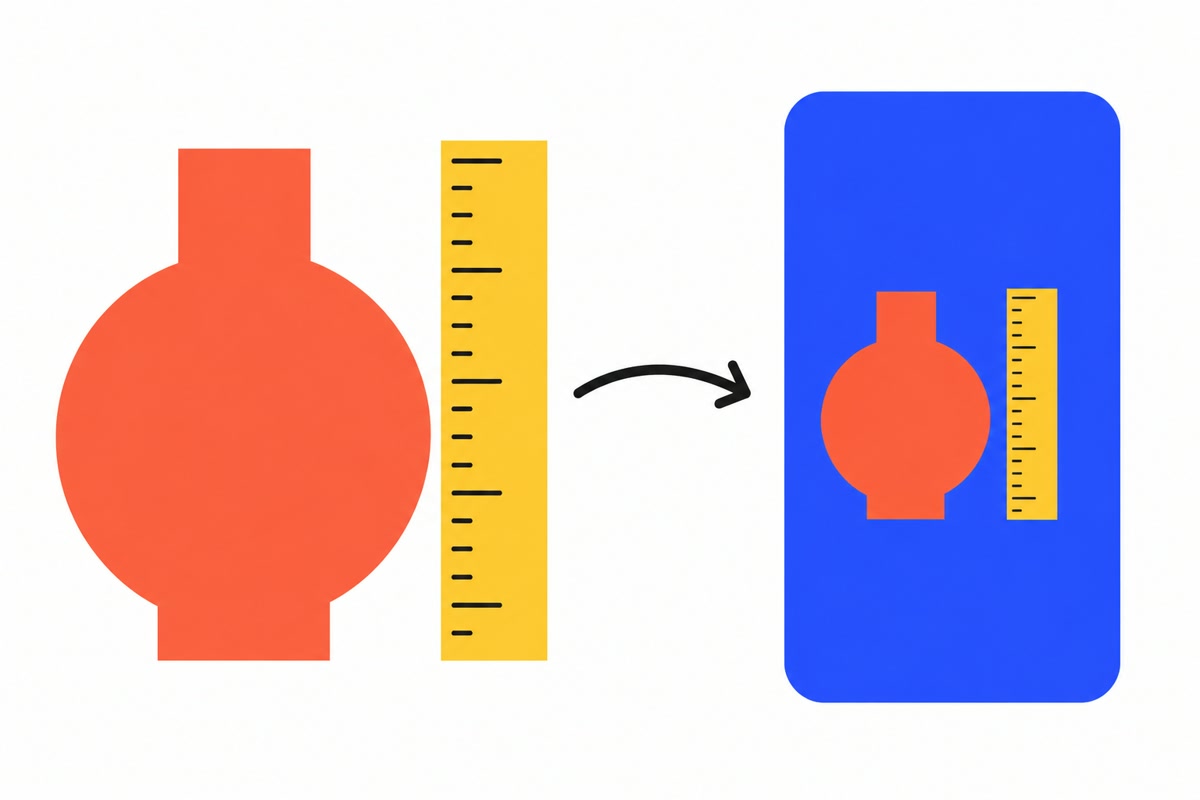
The most straightforward method involves including known reference objects in your photographs. A ruler, color checker card, or standardized object provides immediate scale context.
- Position the reference object parallel to the subject
- Ensure consistent focal plane alignment
- Photograph under controlled lighting conditions
- Document the reference object's exact dimensions
- Calculate pixel-to-measurement ratios during post-processing
This approach works exceptionally well for social media content showcasing physical products. When your audience sees a familiar object alongside your product, they immediately grasp the scale without complex calculations.
Photogrammetric Scaling Techniques
Advanced creators employ photogrammetric methods to create a picture to scale from multiple photographs. This technique reconstructs three-dimensional space from two-dimensional images, allowing precise measurement extraction.
Research published in the ISPRS Archives demonstrates practical experiments with scale bars and scaling workflows in photogrammetry, offering validated methodologies for creators seeking professional-grade accuracy.
| Method | Accuracy Level | Equipment Cost | Learning Curve | Best Use Case |
|---|---|---|---|---|
| Reference Object | Moderate | Low | Easy | Social media, e-commerce |
| Single-Image Calibration | High | Moderate | Moderate | Product photography |
| Photogrammetry | Very High | Moderate-High | Steep | 3D models, technical documentation |
| Laser Scanning | Extremely High | Very High | Very Steep | Professional architectural work |
Software solutions like Agisoft Metashape provide comprehensive tools for creating and applying scale bars, with their official documentation detailing methods for setting absolute scale in 3D reconstructions.
Practical Workflows for Social Media Content
Social media creators face unique challenges when producing a picture to scale. Platform compression, varied display sizes, and rapid consumption patterns demand adapted approaches.
Optimizing Scaled Images for Platform Requirements
Each social platform handles images differently. Instagram's square and vertical formats require different scaling considerations than LinkedIn's horizontal preference or TikTok's vertical video requirements.
Platform-specific scaling strategies:
- Instagram: Include scale references in carousel posts, using the first image to establish context
- Pinterest: Create vertical pins with scale indicators in consistent positions
- LinkedIn: Use professional measurement overlays for B2B product demonstrations
- TikTok: Incorporate dynamic scale comparisons through video transitions
When creating content at scale, maintaining consistency across platforms becomes challenging. This is where automation can transform your workflow while preserving the accuracy that makes a picture to scale valuable.
Maintaining Quality Through Batch Processing
Content creators managing multiple accounts and posting schedules need efficient methods to produce scaled images consistently. Developing templates and presets ensures every picture to scale maintains the same quality standards.
Research on low-cost close-range photogrammetric scanners demonstrates that professional-quality scale-factor estimation doesn't require expensive equipment, making these techniques accessible to independent creators and small teams.

Scale Accuracy and Measurement Standards
Professional content creation demands adherence to measurement standards, particularly when your scaled images influence purchasing decisions or educational outcomes.
Verification Methods and Quality Control
Creating a picture to scale means accepting responsibility for accuracy. Implementing verification steps protects your credibility and ensures audience trust.
- Cross-reference measurements against known standards
- Document your scaling methodology in metadata
- Maintain original, unedited files for future reference
- Conduct periodic calibration checks on measurement tools
- Use multiple verification methods for critical applications
The NIST publications on metrology for 3D imaging systems provide rigorous frameworks for understanding measurement uncertainty and test methods in imaging applications.
Understanding Acceptable Tolerances
Not every application demands micrometer precision. Social media product demonstrations typically accept tolerances of 2-5%, while technical documentation may require sub-1% accuracy.
| Content Type | Acceptable Tolerance | Verification Method | Update Frequency |
|---|---|---|---|
| Social media products | 2-5% | Visual comparison | Per campaign |
| E-commerce listings | 1-3% | Caliper verification | Per product batch |
| Educational content | 1-2% | Multiple measurement points | Per publication |
| Technical documentation | <1% | Calibrated instruments | Every use |
Understanding these tolerances helps you allocate resources appropriately. Spending hours achieving 0.1% accuracy for an Instagram Story wastes time better invested in content creation and engagement.
Automation and Scaling Content Production
Content creators in 2026 face constant pressure to produce more content across more platforms while maintaining quality and authenticity. When you need to create a picture to scale across dozens of posts weekly, manual processes become unsustainable.
Leveraging Smart Automation Tools
Modern automation tools analyze successful content patterns and help creators maintain consistent quality while increasing output. Rather than copying existing posts, sophisticated platforms learn what makes content resonate and apply those principles to original creations.
When you're producing social posts at scale, understanding what makes viral content work gives you a significant advantage. trendoo learns from what goes viral and makes your own social posts at scale, analyzing successful content in your niche to understand the underlying patterns that drive engagement without copying existing posts.

Building Repeatable Processes
Successful scaling requires documented, repeatable workflows. Create standard operating procedures for capturing, processing, and verifying your scaled images.
Essential workflow documentation includes:
- Camera settings and positioning guidelines
- Reference object placement standards
- Lighting setup diagrams
- Post-processing step sequences
- Platform-specific export settings
These documented processes become invaluable when training team members or outsourcing portions of your content creation pipeline.

Advanced Techniques for Professional Results
Professional content creators push beyond basic scaling to create compelling, accurate visual narratives that engage audiences while maintaining technical precision.
Multi-Perspective Scale Demonstrations
Creating a picture to scale from multiple angles provides comprehensive understanding. Product demonstrations showing top, side, and perspective views with consistent scale references give audiences complete dimensional context.
This technique proves particularly valuable for:
- Furniture and home goods (showing how items fit in spaces)
- Technology products (demonstrating size relative to hands or common objects)
- Fashion and accessories (showing proportions on different body types)
- Architectural visualizations (presenting multiple elevation views)
Integrating Scale with Storytelling
The most effective scaled images don't just present measurements; they tell stories. A picture to scale of a compact laptop becomes compelling when shown fitting into a small bag, working on an airplane tray table, or stacked against competing devices.
This narrative approach transforms technical specifications into emotional connections. Your audience doesn't just learn the dimensions; they envision how the product fits their lifestyle.
Practical Challenges and Solutions
Even experienced creators encounter obstacles when producing scaled content consistently. Recognizing common challenges and implementing proven solutions accelerates your workflow.
Lighting and Perspective Issues
Inconsistent lighting creates shadows and highlights that distort perceived scale. Wide-angle lenses introduce perspective distortion that compromises dimensional accuracy.
Solutions include:
- Using diffused, consistent lighting setups
- Selecting appropriate focal lengths (50mm equivalent or longer)
- Maintaining parallel relationships between camera and subject
- Correcting lens distortion during post-processing
Platform Compression and Quality Loss
Social platforms compress uploaded images, potentially degrading scale reference visibility. Text and measurement indicators may become illegible after processing.
Combat this by:
- Uploading at maximum supported resolutions
- Using bold, high-contrast scale indicators
- Testing compressed versions before scheduling posts
- Maintaining larger-than-necessary reference elements
Time Management and Efficiency
Creating accurate scaled images takes time. Balancing quality with production demands requires strategic prioritization.
| Task Category | Time Investment | Quality Impact | Automation Potential |
|---|---|---|---|
| Initial capture | High | Very High | Low |
| Reference placement | Moderate | High | Moderate |
| Post-processing | High | Moderate | High |
| Verification | Moderate | High | Moderate |
| Format adaptation | High | Low | Very High |
Focus manual effort on high-impact activities like initial capture and verification. Automate repetitive tasks like format adaptation and platform-specific resizing. Exploring pricing options for automation tools often reveals that outsourcing routine tasks costs less than the time invested in manual processing.
Industry-Specific Applications
Different industries apply picture to scale techniques with unique requirements and standards.
E-Commerce and Product Marketing
Online retailers depend on accurate product representations to reduce returns and build customer trust. A picture to scale showing a watch on a wrist or a sofa in a living room helps customers make confident purchasing decisions.
Successful e-commerce scaling strategies include:
- Lifestyle images with familiar reference objects
- Dimension overlays on product detail shots
- Comparison images showing size variations
- 360-degree views maintaining consistent scale
Educational and Tutorial Content
Instructors creating DIY tutorials, craft demonstrations, or technical education need precise scaled images. Students must understand exact dimensions to replicate projects successfully.
Educational content benefits from:
- Consistent measurement units throughout tutorials
- Progressive scale demonstrations showing assembly steps
- Clear labeling of critical dimensions
- Downloadable templates maintaining accurate proportions
Architecture and Interior Design
Professionals presenting spatial concepts require extremely accurate scaled representations. Client approval often hinges on understanding how designs translate to physical spaces.
These creators typically employ:
- Floor plans with multiple scale indicators
- Elevation drawings showing vertical relationships
- Perspective renderings with human figures for scale
- Material samples photographed at documented ratios
Future Trends in Scaled Visual Content
The evolution of content creation technology continues reshaping how creators produce and share scaled images.
Augmented Reality Integration
AR applications increasingly allow audiences to place scaled 3D models in their actual environments through smartphone cameras. A picture to scale becomes an interactive experience rather than a static image.
This technology democratizes spatial understanding, letting customers visualize furniture in their homes or see how products compare to objects they own.
AI-Assisted Measurement
Machine learning algorithms increasingly automate measurement extraction from photographs. Upload an image with a reference object, and AI calculates dimensions of every visible item.
These tools reduce manual measurement time while maintaining accuracy, though human verification remains essential for critical applications.
Cross-Platform Scale Consistency
As creators manage content across expanding platform ecosystems, maintaining scale consistency becomes more complex. Emerging tools help synchronize scaled content across platforms, ensuring your picture to scale appears correctly whether viewed on TikTok, Instagram, LinkedIn, or emerging platforms.
Mastering picture to scale techniques empowers content creators to build trust, drive engagement, and differentiate their content in crowded social media landscapes. Whether you're showcasing products, teaching skills, or telling visual stories, accurate scaled images communicate professionalism and attention to detail that resonates with discerning audiences. When you're ready to scale your content production while maintaining quality and authenticity, trendoo analyzes what makes viral content work in your niche and helps you create original posts that start from proven success patterns, all in your unique voice and style.