Scale Picture: How to Create Visual Content at Scale
· 9 min read

Creating visual content at scale has become essential for brands, creators, and marketers navigating the demanding landscape of social media in 2026. The ability to scale picture production without sacrificing quality or brand consistency separates successful content operations from those struggling to maintain relevance. Whether you're managing multiple accounts, running campaigns across platforms, or simply trying to keep up with audience expectations, understanding how to systematically produce visual content determines your competitive position in an increasingly crowded digital space.
Understanding the Scale Picture Challenge
The modern content creator faces a paradox: audiences demand more frequent, higher-quality visual content while platforms multiply and attention spans shrink. To scale picture creation effectively means developing systems that produce volume without compromising the authentic voice and visual identity that audiences connect with.
Traditional approaches to visual content creation break down at scale. Manually designing each graphic, photograph, or video frame becomes unsustainable when you're publishing daily across multiple platforms. Yet batch-creating identical content across channels ignores platform-specific requirements and audience preferences.
The solution lies in building repeatable processes that maintain creative standards while increasing output. This requires understanding three core components:
- Template systems that provide structure without rigidity
- Content variations that adapt core messages to different formats
- Quality controls that ensure brand consistency across volume production
What Makes Visual Content Scalable
Scalable visual content shares specific characteristics that differentiate it from one-off creative work. These elements allow creators to multiply output while preserving the essential qualities that drive engagement.
Modular design principles form the foundation of scalable visuals. Breaking content into reusable components (color palettes, typography systems, layout grids, brand elements) enables rapid assembly of new pieces that feel cohesive. A well-designed modular system lets you produce dozens of variations from a single concept.
Content that scales effectively balances consistency with variety. Your audience should recognize your brand immediately while experiencing enough variation to avoid fatigue. This balance requires intentional planning around which elements remain constant and which adapt to context.

Building Your Scale Picture Workflow
Creating an effective workflow starts with analyzing your current production bottlenecks. Most creators discover that ideation, asset preparation, and quality review consume disproportionate time relative to their value.
Mapping the Production Pipeline
Document every step from concept to publication. Identify which stages require creative judgment versus mechanical execution. Creative decisions (messaging, visual direction, audience targeting) deserve focused attention, while repetitive tasks (resizing, formatting, file organization) need automation or systematization.
Your pipeline should separate strategic work from production work:
- Strategic planning: Define themes, messages, and creative direction
- Asset creation: Develop core visual elements and variations
- Production: Apply templates and systems to generate finished pieces
- Review: Quality control and brand alignment checking
- Distribution: Platform-specific formatting and scheduling
Breaking production into distinct phases reveals opportunities for batch processing. Instead of creating one complete piece at a time, you can generate all strategic plans during one session, then move to asset creation, then to production assembly.
Leveraging Proven Patterns
The fastest path to scalable content production involves learning from successful examples rather than inventing entirely new approaches. When you identify visual content that resonates with your target audience, analyze what makes it work, then adapt those principles to your brand.
This analysis should extend beyond surface aesthetics to underlying structure. What problem does the content solve? How does it open? What progression does it follow? Which elements create stopping power? By understanding these mechanics, you can apply proven frameworks to your own material.
For brands managing social content automation, platforms like trendoo streamline this analysis-to-creation process. Instead of manually dissecting successful posts and recreating their patterns, you can paste a link to viral content and let automation identify the structural elements that drive engagement, then generate original variations that maintain your unique voice and visual style.
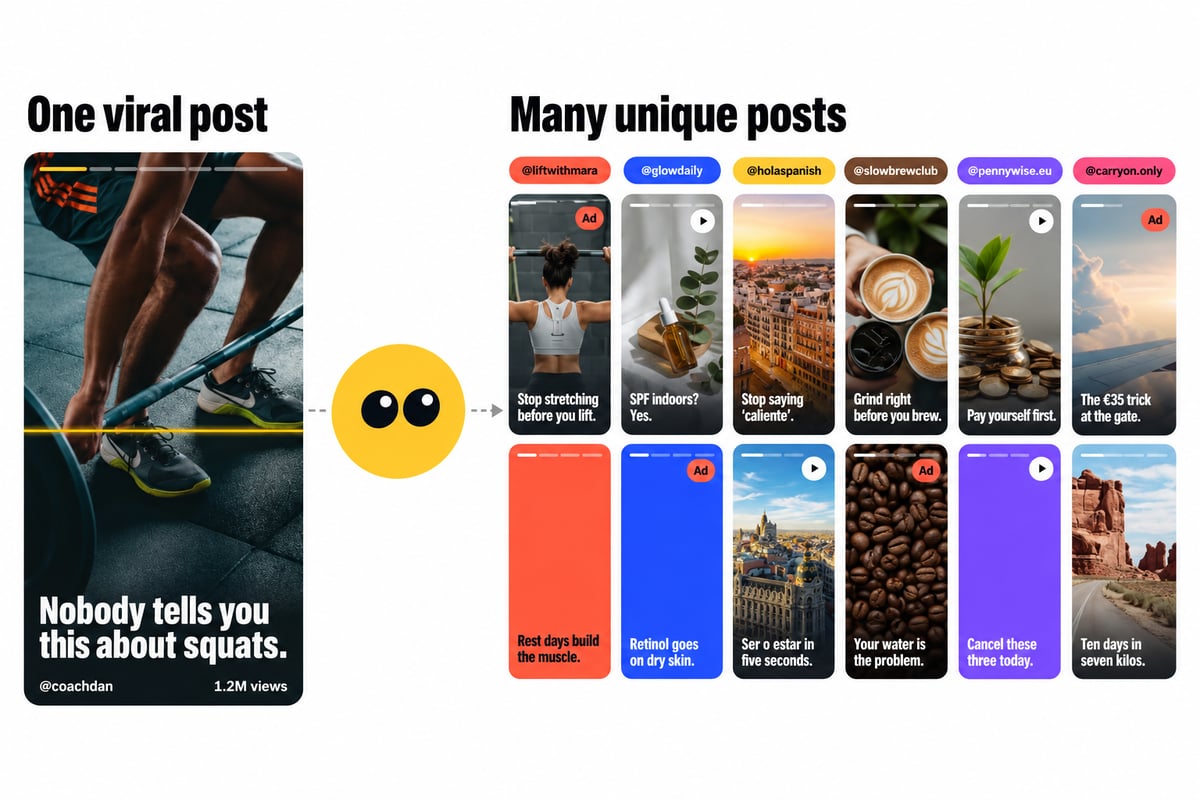
Scale Picture Strategies Across Platforms
Different social platforms demand distinct visual approaches, yet maintaining separate creative workflows for each channel quickly becomes unsustainable. Smart scaling strategies identify commonalities while respecting platform-specific requirements.
Platform-Specific Optimization
Instagram prioritizes aesthetic cohesion and vertical formats. LinkedIn favors professional polish and data visualization. TikTok rewards authentic, rough-edged creativity. Yet underneath these surface differences, principles of clear messaging and visual hierarchy apply universally.
| Platform | Primary Format | Key Visual Element | Scaling Priority |
|---|---|---|---|
| 1080x1350px | Brand aesthetics | Template variations | |
| 1200x627px | Data visualization | Professional polish | |
| TikTok | 1080x1920px | Hook frames | Authentic variety |
| Twitter/X | 1200x675px | Text legibility | Quick production |
| 1200x630px | Emotional resonance | Cross-posting efficiency |
Create a master asset library organized by content type rather than platform. When you develop a concept, produce it once in your highest quality format, then create platform-specific versions through systematic adaptation rather than rebuilding from scratch.
Batch Creation Methods
Batching similar tasks dramatically increases efficiency. Dedicating specific time blocks to single activities (writing all captions, designing all templates, editing all images) reduces context switching and accelerates production.
Consider these batching approaches:
- Thematic batches: Produce all content related to a campaign or topic simultaneously
- Format batches: Create all carousel posts, then all single images, then all videos
- Platform batches: Generate a week's worth of Instagram content, then LinkedIn, then Twitter
The optimal batching strategy depends on your team size, content volume, and platform priorities. Experiment with different approaches and measure how they affect both output quantity and creative quality.

Quality Control at Volume
Maintaining standards becomes challenging as production volume increases. Without systematic quality controls, scaled content risks becoming generic or off-brand.
Establishing Brand Guidelines
Comprehensive brand guidelines serve as your quality baseline. These should cover visual elements (colors, fonts, imagery style, logo usage) and voice characteristics (tone, vocabulary, messaging themes). The more specific your guidelines, the easier maintaining consistency becomes.
Create decision trees for common scenarios. When should you use bold typography versus script fonts? Which color combinations signal different content types? How do you adapt brand voice for educational versus promotional content? Documenting these decisions prevents quality drift.
Review and Approval Processes
Scaled production requires streamlined review. Avoid bottlenecks where every piece needs individual executive approval. Instead, establish clear parameters for what requires review versus what creators can publish independently.
Tiered approval systems work well at scale:
- Auto-approval: Content following established templates and guidelines
- Peer review: New formats or messaging requiring quick feedback
- Leadership review: Strategic campaigns or sensitive topics
Technology enables efficient review workflows. Cloud-based tools let teams comment directly on designs, track revision history, and maintain approval records without endless email threads.
Measuring Scale Picture Performance
Production efficiency means nothing without performance data. Tracking which visual content drives engagement, conversions, and audience growth informs future creation priorities.
Essential Metrics for Visual Content
Different goals require different metrics. Brand awareness campaigns prioritize reach and impressions. Conversion-focused content tracks click-through rates and actions taken. Community-building content measures comments, shares, and follower growth.
Focus on comparative metrics rather than absolute numbers. How does carousel performance compare to single images? Do vertical videos outperform horizontal? Which color schemes drive highest engagement? These insights guide resource allocation.
| Metric Type | What It Measures | Scaling Application |
|---|---|---|
| Engagement rate | Audience interaction per impression | Template effectiveness |
| Click-through rate | Traffic generation | Call-to-action design |
| Share rate | Content virality | Emotional resonance |
| Save rate | Long-term value | Educational quality |
| Completion rate | Video retention | Pacing and hooks |
Iterative Improvement Systems
Scale picture strategies should evolve based on performance data. Establish regular review cycles (weekly, monthly, quarterly) where you analyze results and adjust production priorities.
A/B testing at scale provides definitive answers about what works. Test single variables (headline phrasing, image style, color scheme) across similar content pieces. Accumulating these insights over time builds a proprietary playbook of what resonates with your specific audience.
Document learnings in accessible formats. Many teams maintain internal wikis or shared documents cataloging what works, what doesn't, and why. This institutional knowledge prevents repeating mistakes and accelerates new team member onboarding.
Automation and Tool Selection
The right technology stack multiplies human effort without replacing creative judgment. Selecting tools that integrate smoothly and support your specific workflow prevents the common trap of managing tools instead of creating content.
Categories of Scale Picture Tools
Modern content operations typically employ tools across several categories. Design platforms (Canva, Adobe Creative Suite) handle visual creation. Asset management systems organize files and maintain version control. Scheduling platforms distribute content across channels. Analytics tools track performance.
Integration between tools matters as much as individual capability. Seamlessly moving from design to scheduling to analytics prevents manual export/import cycles that introduce errors and waste time.
Consider these selection criteria when evaluating tools:
- Learning curve: Will your team actually use it, or will complexity create adoption resistance?
- Scalability: Does pricing and capability grow with your needs?
- Platform support: Does it connect to your active social channels?
- Collaboration features: Can teams work together efficiently within the tool?
- Template capabilities: Does it support reusable frameworks that accelerate production?
Balancing Automation and Authenticity
Automation should enhance creativity rather than replace it. The goal isn't removing humans from content creation but freeing them from repetitive tasks to focus on strategy and innovation.
Over-automation creates generic content that audiences ignore. The most successful scaled operations use automation for mechanical tasks (resizing, scheduling, file management) while preserving human judgment for creative decisions (messaging, visual concepts, audience targeting).
Smart automation learns from successful patterns. By analyzing which content performs well, systems can suggest approaches likely to resonate. This guidance accelerates creation without dictating creative choices.
Looking at pricing for content automation tools, evaluate not just monthly costs but time savings and performance improvements. A tool that costs more but increases engagement rates or reduces production time often delivers better ROI than cheaper alternatives.
Team Structures for Scaled Production
Whether you're a solo creator or managing a content team, organizational structure significantly impacts scaling capability. Clear roles, efficient communication, and skill specialization all contribute to sustainable high-volume production.
Role Definition and Specialization
Small teams benefit from T-shaped skills: broad competence across the content creation process with deep expertise in specific areas. One person might handle both strategy and copywriting, while another combines design and video editing.
As teams grow, specialization increases efficiency:
- Content strategists plan themes, messaging, and campaign direction
- Designers create visual templates and branded assets
- Writers develop copy, captions, and scripts
- Editors ensure quality and brand consistency
- Analysts track performance and inform optimization
Even specialized teams need cross-training. When designers understand strategy and strategists grasp design constraints, collaboration improves and bottlenecks decrease.
Communication and Workflow Management
Asynchronous communication supports distributed teams and reduces meeting overhead. Document decisions, share updates in written form, and use project management tools to track progress without constant check-ins.
Establish clear workflows that answer common questions: Who creates initial concepts? Who reviews before publication? Where do assets get stored? When are deadlines? Documenting these processes prevents confusion and enables autonomous work.
Regular retrospectives help teams refine processes. Monthly sessions reviewing what worked well and what created friction generate actionable improvements to workflows, tool usage, and communication patterns.
How specialized roles (strategist, designer, writer, editor, analyst) collaborate through documented workflows and project management systems to scale social media content production
Future-Proofing Your Scale Picture Strategy
Social platforms evolve constantly. Algorithm changes, new features, and shifting audience preferences require adaptable systems rather than rigid processes. Building flexibility into your scaling strategy ensures long-term sustainability.
Building Adaptive Systems
Modular workflows adapt more easily than monolithic processes. When you can swap components (changing design tools, adjusting review processes, adding platforms) without rebuilding entire systems, you respond faster to market changes.
Maintain a portfolio approach to content formats. Don't over-invest in single formats or platforms. Diversifying across video, images, carousels, and text-based content protects against algorithm changes favoring specific types.
Continuous Learning and Skill Development
The tools, platforms, and best practices for visual content creation shift rapidly. Dedicating time to learning new capabilities, exploring emerging platforms, and experimenting with novel formats keeps your approach current.
Create space for experimentation within production schedules. Reserve 10-20% of capacity for testing new ideas, formats, or platforms without the pressure of immediate performance requirements. These experiments often reveal future mainstream strategies.
Stay connected to creator communities and industry resources. What works for others in your niche provides valuable insights, while cross-industry observation reveals approaches you can adapt to your context.
Scaling visual content production requires systematic approaches that balance efficiency with creativity, consistency with variation, and automation with authentic human judgment. By building modular systems, leveraging proven patterns, and maintaining rigorous quality controls, brands can dramatically increase output without sacrificing the unique voice that connects with audiences. When you're ready to transform how you approach social content creation at scale, trendoo helps you learn from viral content and generate original posts that maintain your brand voice across multiple accounts and platforms.